World-Action Models · Robot Manipulation · Interpretability

HeadLight

Targeted Adaptation of World-Action Models via Interaction and Motion Heads

TL;DR Pretrained World-Action Models already contain a few attention heads that track where to interact next and others that track how the robot and objects move. HeadLight finds them and fine-tunes only those heads. It beats full fine-tuning and LoRA on unseen tasks while updating 1.1% of the parameters.

62.3%
success on unseen RoboTwin tasks (Zero-WAM)
+4.4 pts over full FT · +3.6 over LoRA
1.1%
of parameters updated
113M of 10B · no inference overhead
57.9→0.9%
success after removing the 48 Motion Heads
48 random heads: 47.4%
72.5%
real-robot success on unseen tasks (LingBot-VA)
+11.25 pts over LoRA
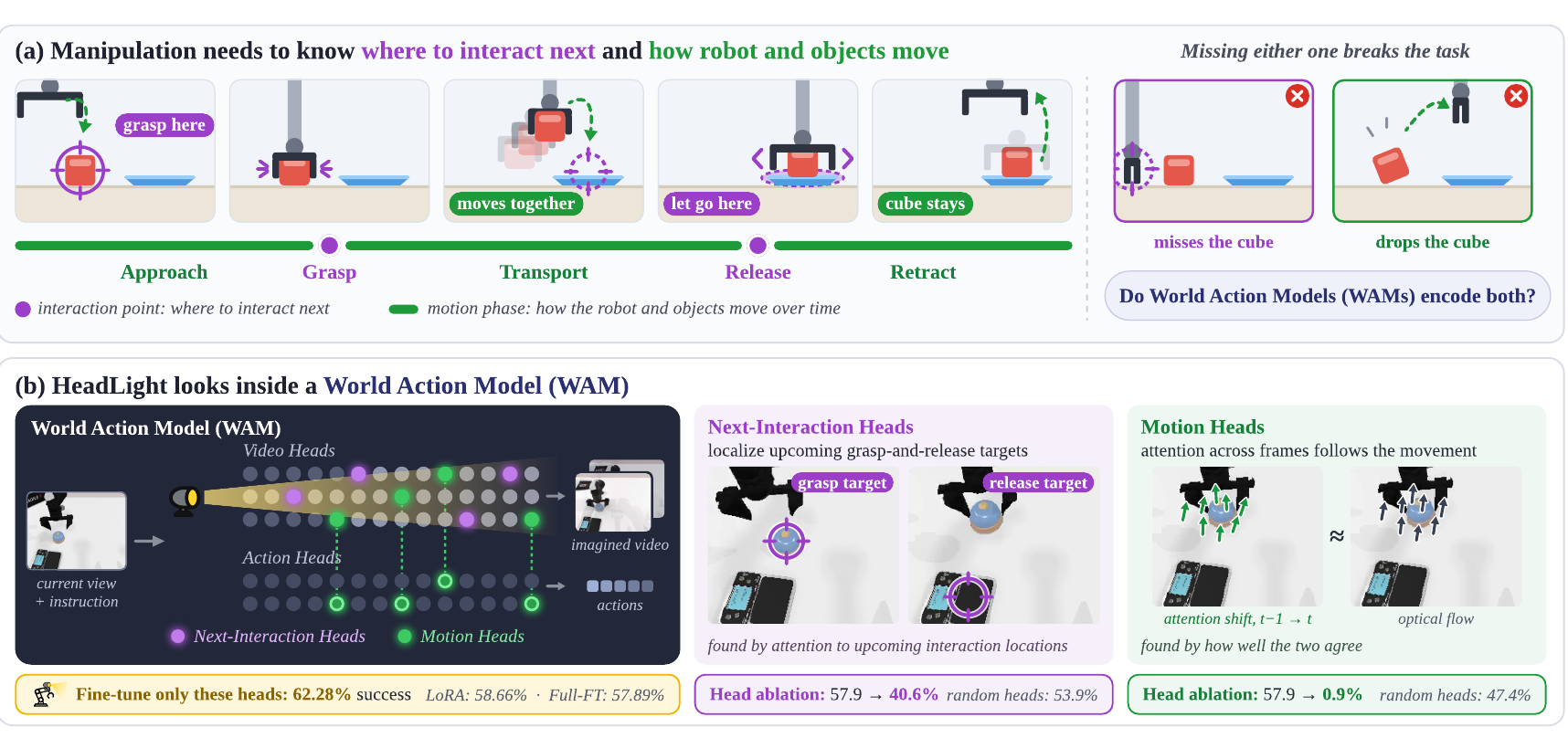
Figure 1: Manipulation needs to know where to interact next and how the robot and objects move. HeadLight finds Next-Interaction Heads and Motion Heads inside a World Action Model.
HeadLight looks inside a World-Action Model. (a) Successful manipulation requires both localizing where to interact next and modeling how the robot and objects move. If either is missing, the task fails. (b) Inside pretrained WAMs we find Next-Interaction Heads, which localize upcoming grasp and release targets, and Motion Heads, whose cross-frame attention aligns with optical flow. HeadLight fine-tunes only these heads.

Abstract

World-Action Models (WAMs) are a promising new paradigm of robot manipulation policies that jointly generate future video and actions. Successful manipulation requires both identifying where to interact and modeling how the robot and objects move. Yet standard adaptation methods, such as full fine-tuning and LoRA, do not explicitly select parameters aligned with these manipulation-specific capabilities. Motivated by this challenge, we discover two functionally specialized families of attention heads: Next-Interaction Heads, which localize upcoming grasp-and-release targets, and Motion Heads, which track movement across frames. Furthermore, we introduce HeadLight, a parameter-efficient refinement method that jointly adapts Next-Interaction Heads and Motion Heads.

On RoboTwin tasks unseen during fine-tuning, HeadLight achieves 62.28% success, compared with 57.89% for full fine-tuning and 58.66% for LoRA, while updating only 1.1% of parameters. Inference-time ablations further validate the functional importance of these heads: ablating Motion Heads reduces manipulation success from 57.89% to 0.94%, while ablating Next-Interaction Heads lowers it to 40.61%, both substantially more than ablating equally many random heads. Finally, we show that our approach is effective across multiple WAM architectures and real-robot manipulation settings.


Two families of specialized heads

Manipulation alternates between discrete contact events (grasp, release) and continuous motion. We score every one of the 720 video attention heads in a frozen WAM on both axes. A small, disjoint set of heads stands out on each.

24 heads

Next-Interaction Heads

Where to interact next

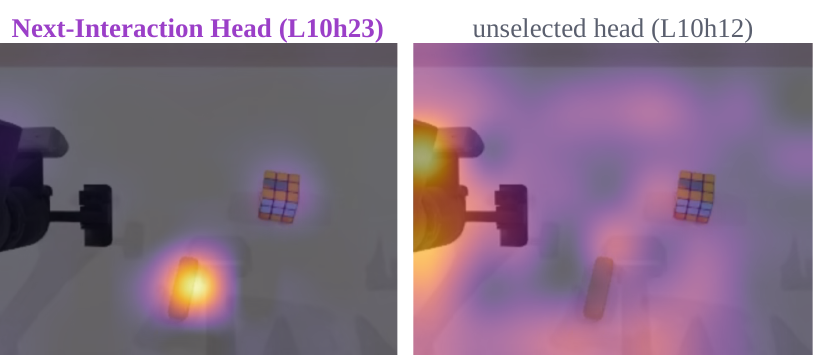
Attention map of Next-Interaction Head L10h23 focusing on the upcoming grasp target, next to an unselected head with diffuse attention.

To find them, we mask the token covering the upcoming interaction target and measure how much each head's output changes. We compare that change against four control tokens: a random token, one equidistant from the gripper, the previous target, and the target after next. A head counts only if the true next target matters more than every control.

$$S_N(\ell,h)=\min_{c}\,\log\frac{\mathbb{E}_f\!\left[\Delta_{\ell,h}(\mathcal{T})\right]}{\mathbb{E}_f\!\left[\Delta_{\ell,h}(\mathcal{C}_c)\right]}$$

The selected head locks onto the grasp target and ignores the distractor. A same-layer unselected head attends diffusely.

48 heads

Motion Heads

How the robot and objects move

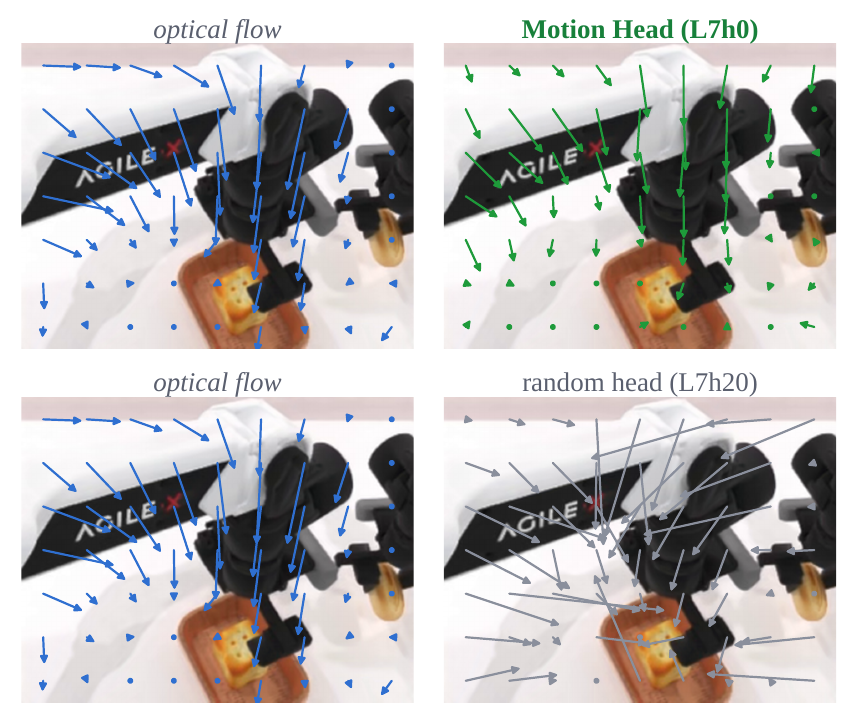
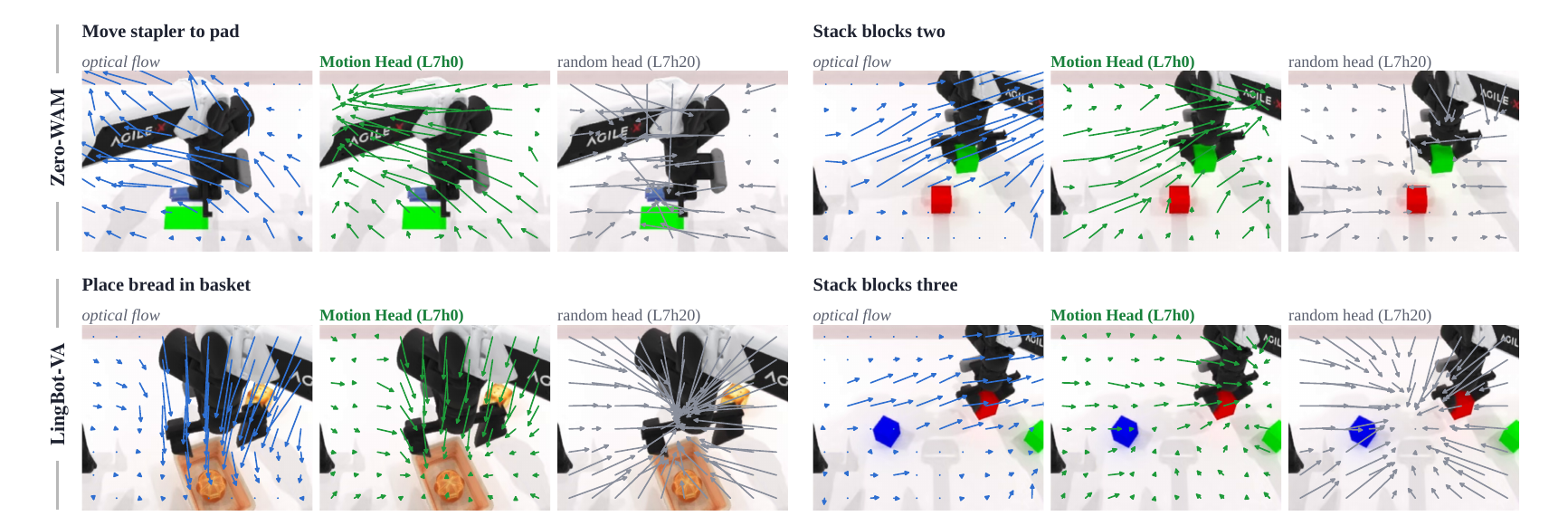
Optical flow compared with the attention-induced motion field of Motion Head L7h0, which matches it, and random head L7h20, which does not.

Each head's cross-frame attention defines a motion field: every patch points to where it attends in the previous frame. We score heads by how well that field agrees with optical flow, using cosine similarity.

$$S_M(\ell,h)=\mathbb{E}_{f,p}\!\left[\cos\!\big(\hat{\mathbf{u}}^{f}_{\ell,h}(p),\,\mathbf{u}^{f}(p)\big)\right]$$

Motion Head L7h0 tracks the moving arm and gripper. Random head L7h20 gives disorganized offsets.

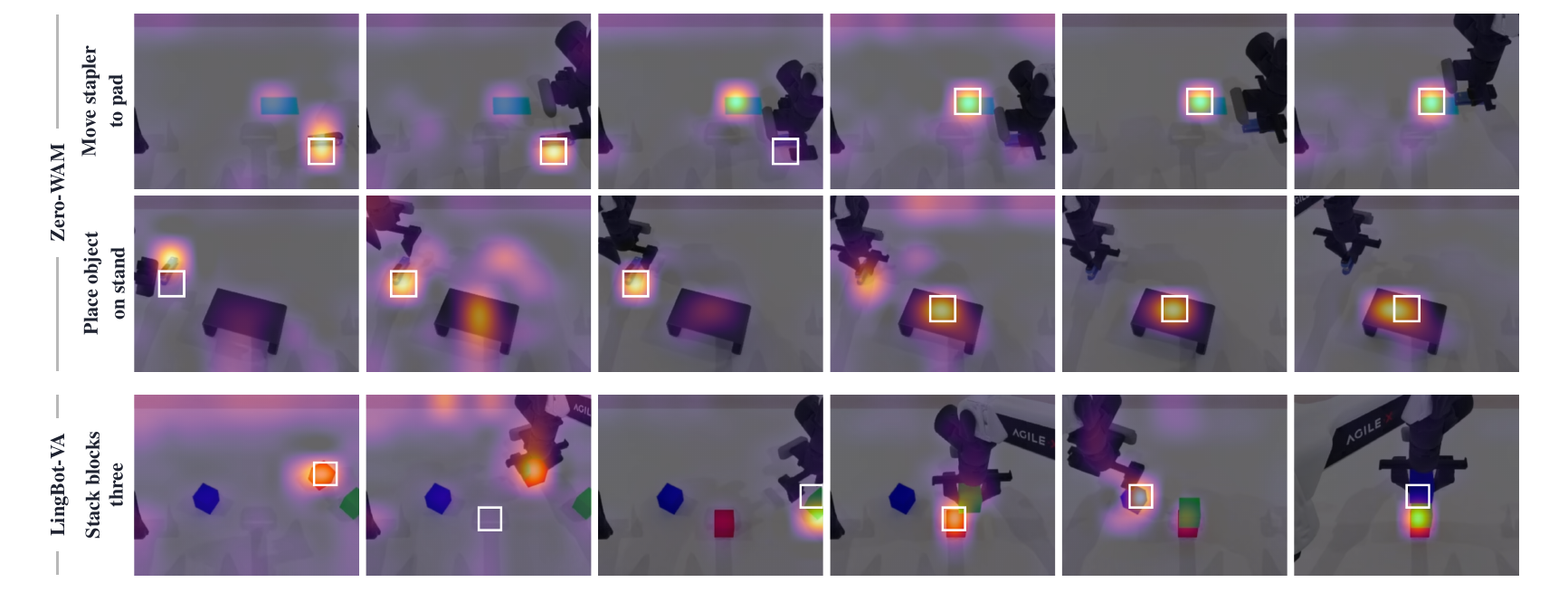
Attention maps of a Next-Interaction Head across consecutive frames in Zero-WAM and LingBot-VA, moving from grasp target to release target.
The white square marks the upcoming interaction target. In Zero-WAM (L10h23), attention sits on the object to be grasped. Once the object is grasped, it shifts to the release location. LingBot-VA (L11h10) shows the same behavior.

Method

HeadLight is a one-time head discovery step, a causal check, and a targeted fine-tune. Both pathways use a single forward pass. Updates are additive, so they merge into the base weights and inference cost stays the same.

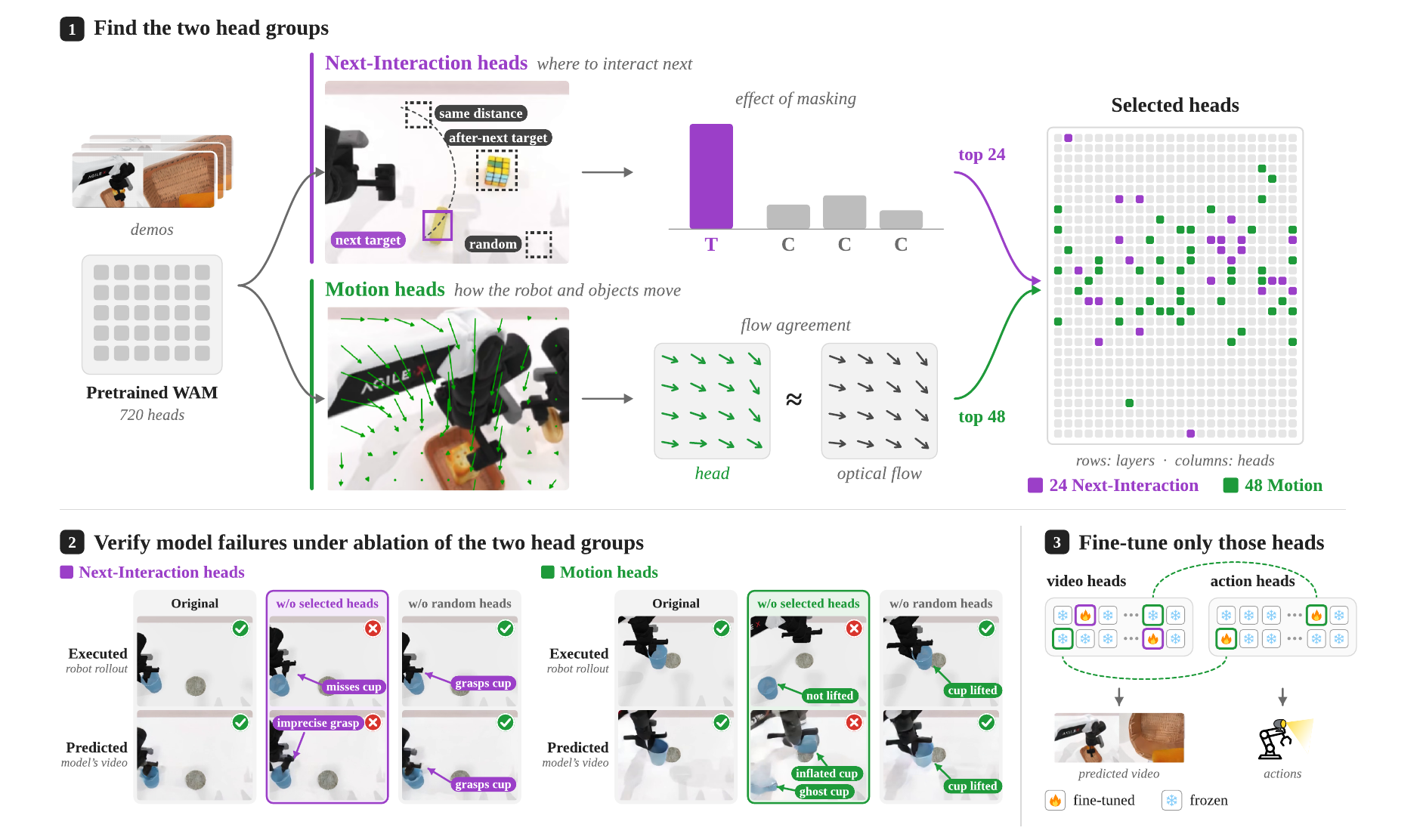
Overview of HeadLight: find the two head groups, verify model failures under ablation, and fine-tune only those heads.
  1. 1

    Find the two head groups

    We run one teacher-forced pass of the frozen WAM over a few demonstrations per task and score all 720 video heads. The top KN=24 by SN and the top KM=48 by SM are kept. No gradients are needed, and the sets are reused across downstream tasks.

  2. 2

    Verify they matter

    Removing each group at inference causes a distinct failure. Without Next-Interaction Heads, the robot misses the cup. Without Motion Heads, the predicted video shows ghosted, inflated objects and execution stalls. Removing the same number of random heads leaves the rollout largely intact.

  3. 3

    Fine-tune only those heads

    Video pathway: the video loss updates only the 24 Next-Interaction Heads, which sharpens where grasps and releases appear in the predicted video. Action pathway: the video Motion Heads stay frozen. The action loss updates their 48 paired action heads, so actions follow the predicted motion.

Generalization to unseen tasks

Every method is adapted on 43 seen RoboTwin 2.0 tasks and evaluated on 6 unseen tasks (100 trials × 3 seeds each). LoRA's rank is chosen to match HeadLight's parameter budget (113.5M vs. 113.3M).

Average success on unseen tasks

Per-task success rate (%, mean ± std over 3 seeds)

Removing heads at inference

Zero-WAM after full FT, unseen tasks. Lower success means the heads matter more.

The two sets are disjoint among all 720 video heads. Removing the 48 Motion Heads drops success to near zero.

The two pathways are complementary

Zero-WAM, unseen tasks. Each pathway is compared with an equally sized random-head control.

Each pathway alone beats its random-head control. Combining them adds more than 6 points over either pathway alone.

Same scene, different outcome

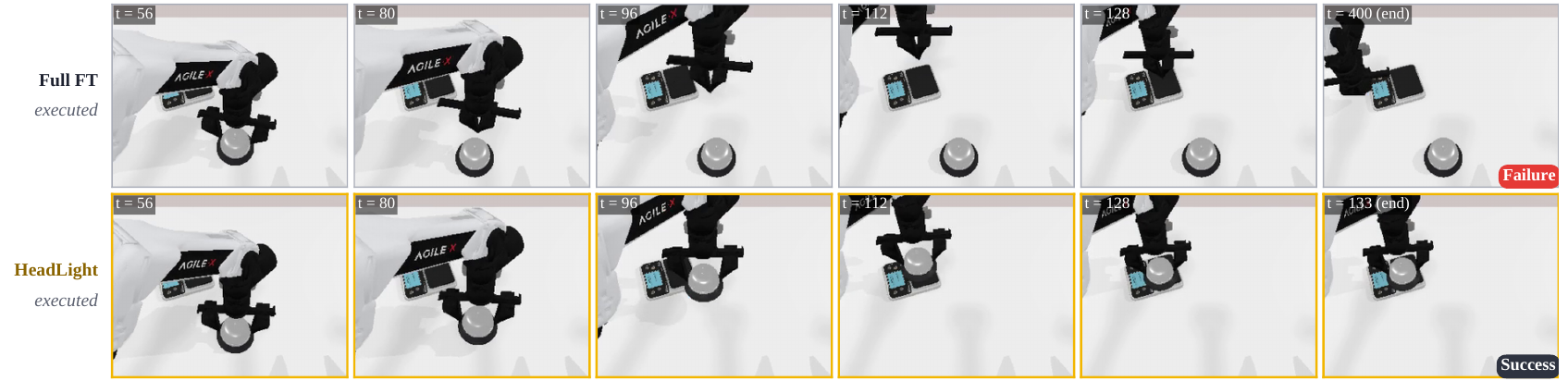
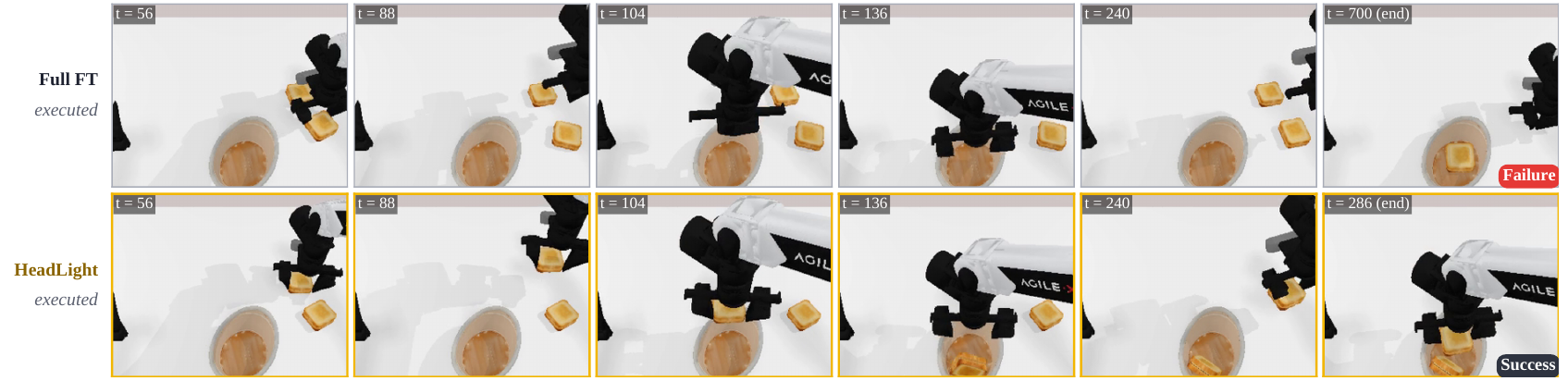
Full FT closes on the object but fails to lift it; HeadLight grasps and places it on the scale.

Executed head-camera frames at matching action steps on identical unseen scenes (Zero-WAM). Full FT closes its gripper on or beside the object but fails to lift it. HeadLight grasps, carries, and places the object.

The heads exist in other WAMs too

We rediscover both head families on four more public WAM checkpoints, without fine-tuning, and remove them at inference. Each removal is compared with removing the same number of random video heads.

ModelBenchmarkOriginalNext-InteractionMotion
randomselectedrandomselected
Fast-WAMRoboTwin 2.091.990.085.691.890.5
MotusRoboTwin 2.088.785.985.585.075.8
OpenWAM-πLIBERO99.398.691.999.498.5
Cosmos3-EdgeLIBERO98.081.951.796.637.5

Values are success rates (%). The size of each drop depends on how the model routes video information to actions. For example, Motion Heads matter most when actions depend on predicted future frames.

Real-robot manipulation

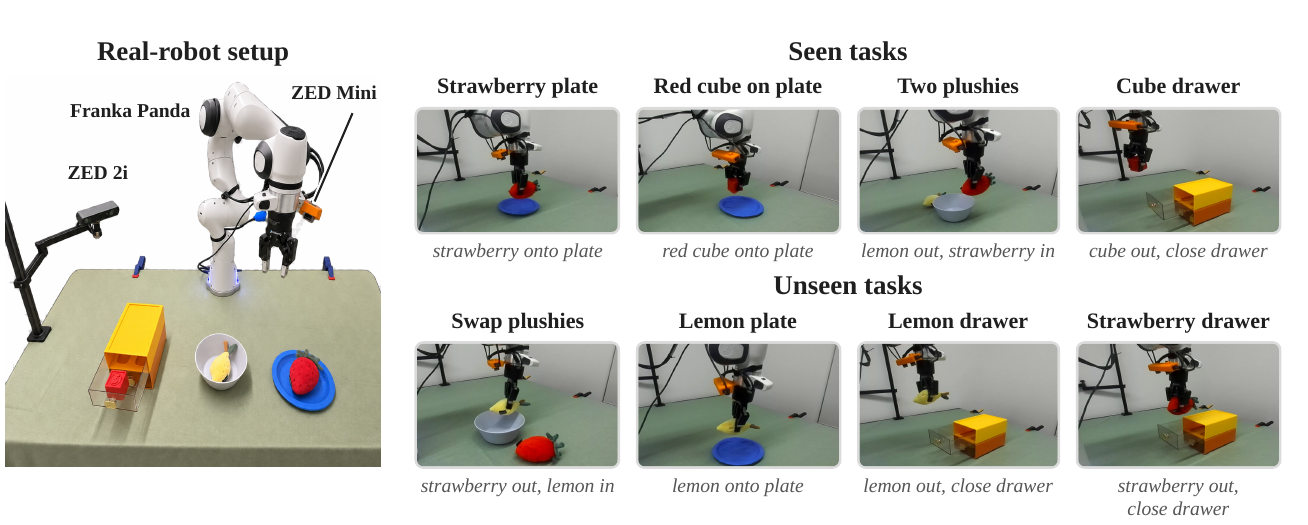
This uses a Franka Panda with a third-person ZED 2i and a wrist-mounted ZED Mini. Policies are adapted on four seen tasks (100 teleoperated demos each). They are tested on those four tasks and on four unseen tasks that recombine the same objects into new goals. Each task gets 20 rollouts.

Real-robot workspace with a Franka Panda, and the four seen and four unseen tasks.

Average success rate

Rollout browser

Seen
Unseen

BibTeX

@article{zhu2026headlight,
  title   = {Targeted Adaptation of World-Action Models via Interaction and Motion Heads},
  author  = {Zhu, Yuze and Li, Jacky and Luo, Yusen and Zheng, Ken Jiankun and
             Mitra, Chancharik and Darrell, Trevor and Herzig, Roei},
  journal = {arXiv preprint},
  year    = {2026}
}